Beginning in spring of 2025, we have started to ask ourselves, as a research group, what kind of computing discipline do we want to work in? Inspired by Ursula K. Le Guin’s 1986 essay “The Carrier Bag Theory of Fiction” we asked ourselves: What does computing look and feel like to us? What do we want computing to look and feel like? And what type of knowledges are we drawing on in our work?
Keeping our commitment to Participatory Design we did not want to think about these questions by ourselves but together with the communities we surround ourselves with, starting in the field of Human-Computer Interaction (HCI). Initiating this exchange, we want to offer an opportunity for a communal weaving, for critique, reflection, and exchange grounded in material and slow practice. Taking a step back, let us shortly lay out what we suggest for a different way of computing research:
In 1986, feminist sci-fi writer Ursula K. LeGuin introduced The Carrier Bag Theory of Fiction – a meditation on the stories we tell about science and technology, and how they could be told otherwise (1986). LeGuin, drawing on Elizabeth Fisher’s (1979) The Carrier Bag Theory of Evolution, invites science fiction writers to let go of “killer stories” that centre heroic, masculine, war-oriented technologies and portray development as triumph, and instead re-orient towards more mundane yet no less essential technologies (such as carrier bags) that give rise to different stories (stories that centre care and community, for instance). LeGuin’s (1986) text became fundamental for thinking about sci-fi and other forms of writing, and inspired revisions of methods and historiographies in multiple other domains, including media studies, architecture, technology, (cultural) criticism, and others. As LeGuin (1986) invites science fiction writers to let go of killer stories as “Herculean, Promethean, conceived as triumph”, we similarly want to suggest a practice of computing that moves away from the grand inventions and applications at scale and instead seeks out questions around material concerns, situations, and places.
While computing, and especially HCI, has its beginnings in interdisciplinarity, drawing on knowledge from the fields of engineering, psychology, and behavioural sciences, our critique is with the marginalisation of knowledges from the social sciences and humanities that are not readily operation able for computational practices. LeGuin’s (1986) carrier bag suggests stories of the mundane, of slow processes, of practices of sharing and bringing home. We hope to inspire a similar communal practice for computing practitioners as well.
To this end, we suggest a Carrier Bag Practice of Computing: In its broadest strokes, we propose a carrier bag practice as a figuration, a lens, and a metaphor, with the aim of shaping a more just and response-able (Haraway, 2016) discipline, so the computing scholars of the future would be trained to be composers rather than engineers. It could inspire a computing education that weaves together diverse ways of knowing, instead of following a linear path to technical mastery only. It can be used as a magnifying glass for the minor trajectories of computing that is grounded in material concerns and the vernacular. The aim of a carrier bag practice is to move away from the grand inventions and applications at scale so prevalent in the discipline’s killer stories (LeGuin, 1986), and instead send out an invitation to ask about material concerns, situations, and places. The carrier bag therefore offers a broader grounding for computer science that exceeds mathematical knowledge and instead is a collection of knowledges, approaches, expertise, and ideas one encounters on their (academic) path, grounded in a feminist ethics of care (Tronto & Fischer, 1990; Tronto, 1998; DeLa Bellacasa, 2017). In other words, the carrier bag is an invitation to start the construction of a different trajectory for computing practices, their presence, and future.
The complete extended abstract is available online as well: Communal Weaving for a Carrier Bag Practice of Computing
The first threads: Imagining a Communal Weaving
Thinking computing, threading, and weaving together is not a far-fetched idea, on the contrary: There is long but often overlooked interwoven history between weaving technologies and the origins of computing:
Threading and weaving have long been used to imagine automation and computing. The Jacquard loom, using punched cards to control complex woven patterns, is often named as one of the direct ancestors of programmable machines (Essinger 2007). It was this same logic of punched cards that Ada Lovelace and Charles Babbage drew on when working on the Analytical Engine. Lovelace recognised:
“We may say most aptly that the Analytical Engine weaves algebraical patterns just as the Jacquard-loom weaves flowers and leaves.” (Gross 2015)
Weaving is part of computing’s own history, quietly present in code architecture. Feminist scholarship has long pointed out that this history has usually been told in a way that focuses on individual male pioneers and great engineers, erasing crafting practices and those who cultivate them, which were essential to computing’s development.
When considering ways to engage our reflections of computing and HCI as a discipline and how they could be shaped differently by a carrier bag practice, fabric-based crafts came to mind, not only in line with computing’s history, but also because of their ability to make abstract computational concepts more tangible (see for example Keune 2022; Keune 2024). By focusing on practices of weaving and fabric we aim to tell a story of computing that is collective, iterative, and materially grounded knowledge-making, passed on through careful hands.
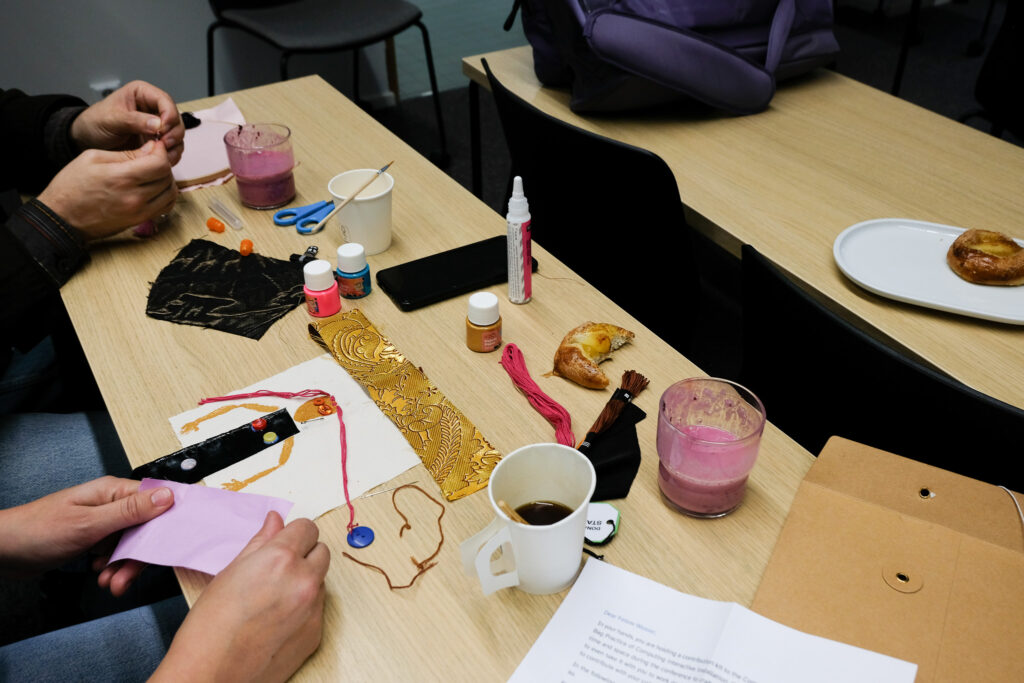
So, to make the first thread our research group met for an initial weaving session, asking ourselves: What does computing look and feel like to us? What do we want computing to look and feel like? What type of knowledges do you draw on in your work? Thereby the aim of the workshop was to materialise our ideas for a communal carrier bag practice in an interactive installation piece through fabric-based crafting.
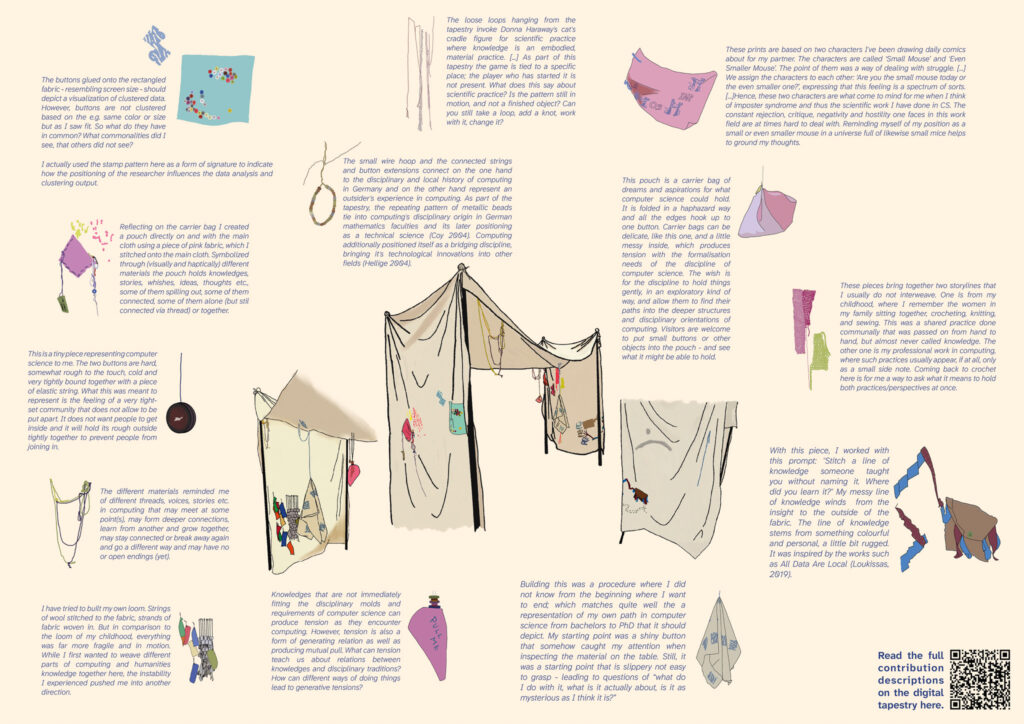
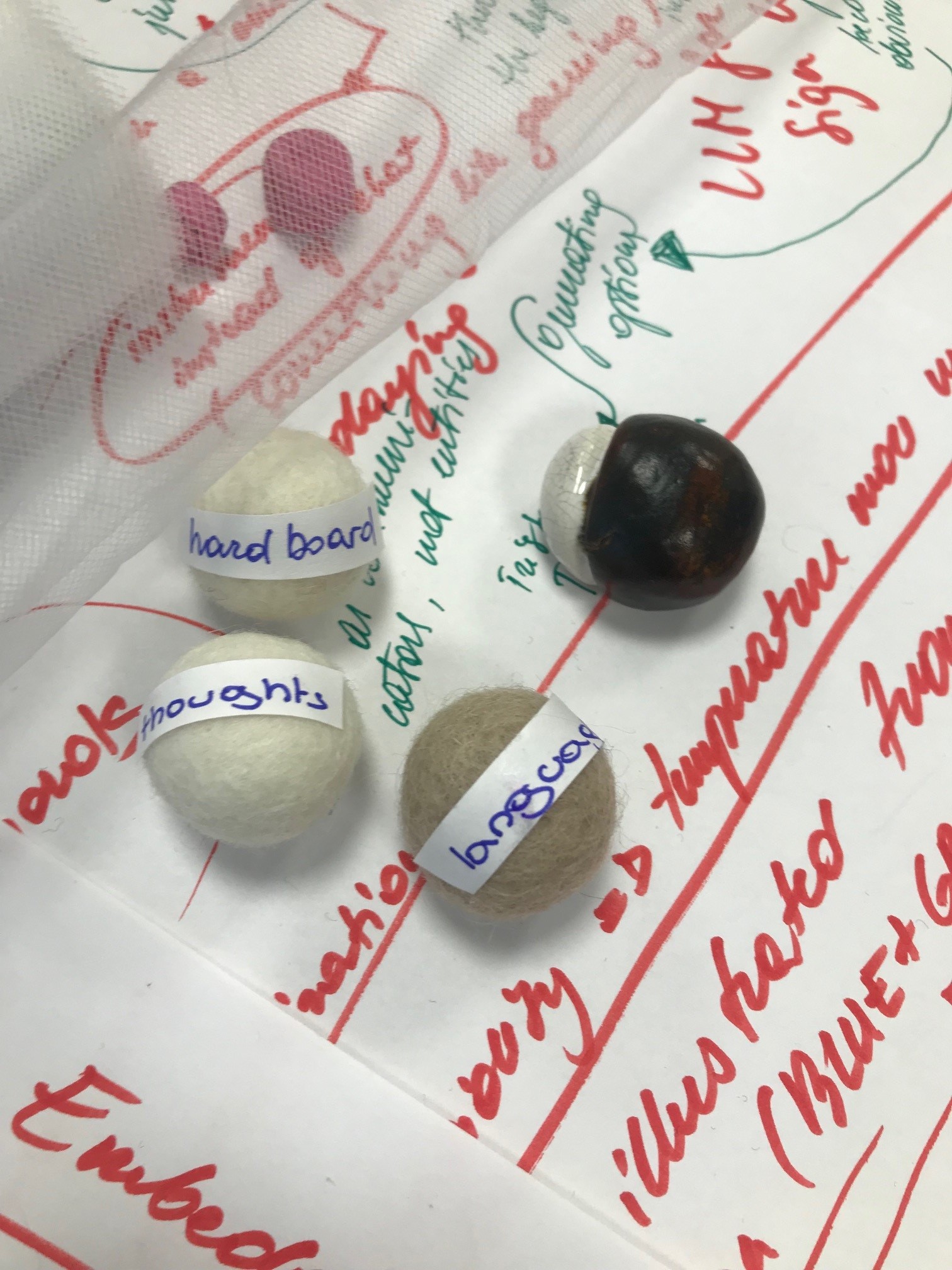
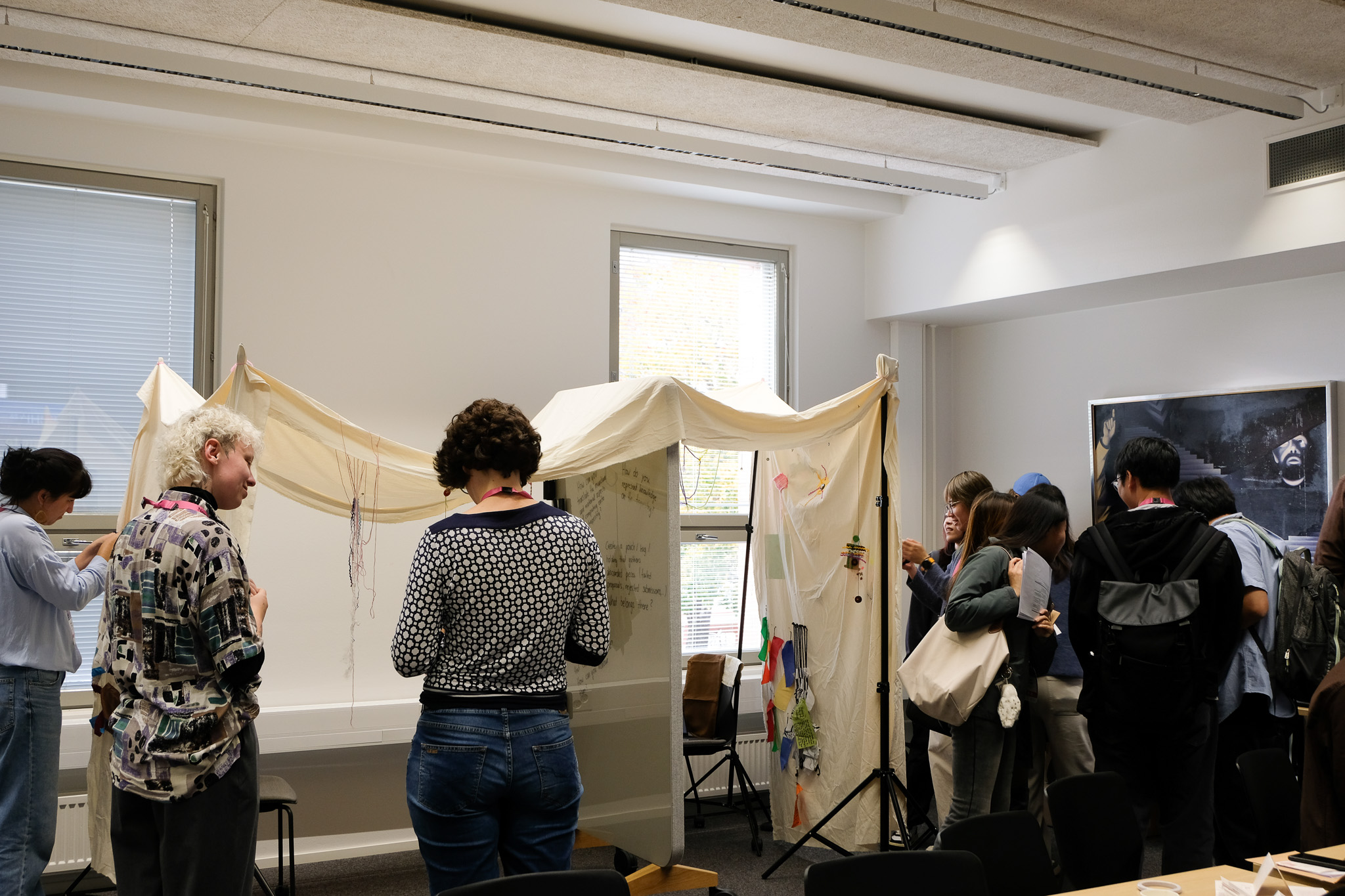
As spaces of reflection and creative engagement require time and groundedness in oneself, the workshop started with some warm-up exercises to arrive in that headspace. Afterwards inspirational and reflective prompts as well as guided engagement with the material at hand set the starting point of the session. Soon the room turned quite, only the rustling sounds of buttons moving past each other, brushstrokes on scraps of fabric, and sewing sounds filled the room. What in the moment felt like a meditation due to the engagement with soft materials, in contrast to the familiar cold and plain feeling of a computer’s keyboard, ended with various materialisations of our individual relationships to computing and the knowledges we see (non-) fit or miss.
The reflections connected to all weavings created in this first workshop, alongside images and feel-trough me descriptions can be found here: Digital Tapestry of a Carrier Bag Practice of Computing
The first thread, waiting to be taken up by fellow researchers, has been spun – ready to be sent to NordiCHI 2026.
To get an impression of these first threads, you can see some of the pieces in the video below and listen to the weavers explain their thoughts and reflections:
Reflections from Vaasa, Finland
Viktoria Horn:
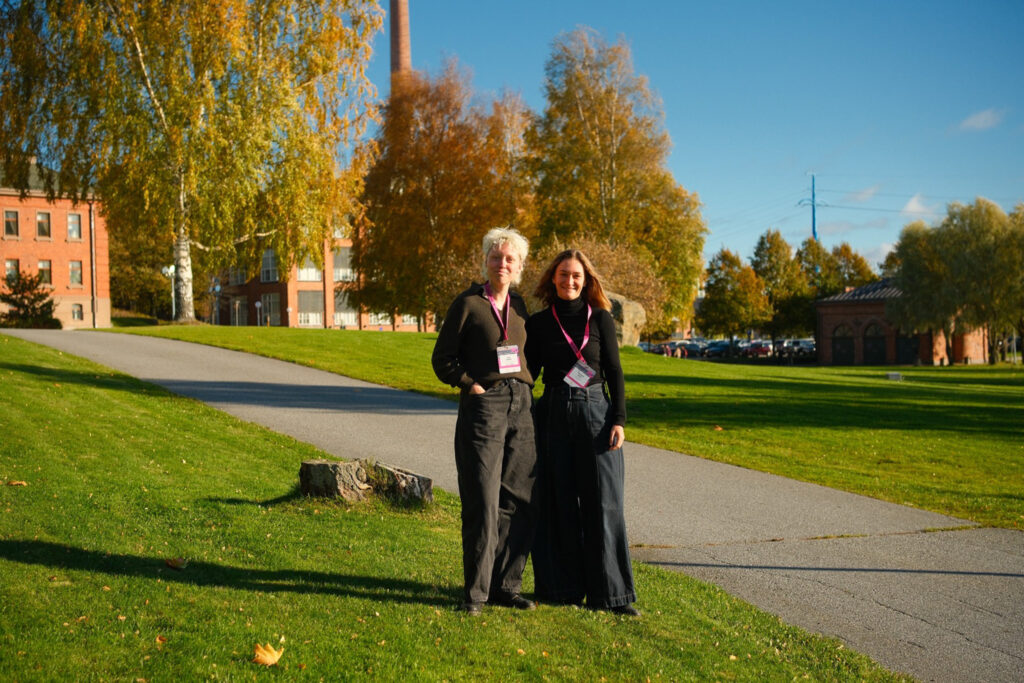
“The NordiCHI conference has established itself as the Scandinavian homecoming for HCI researchers. Not being from the Nordics myself, but with strong academic ties as one of the birth places of participatory design, the conference has become a place where I feel home academically and encountered familiar faces. But, like every family mingling, there was also room for disagreement and disappointment, sparked e.g. by uncritical AI enthusiasm. So after my first visit to NordiCHI in 2024, where I tried to get as much “general” experience in as I could, this time I turned towards the critiques, art-based approaches and personal projects.
In general, I experienced the critique papers as very engaging, focusing not only on critiques, but also state of the art reflections on how HCI and computing research in general can move (or should not move) forward. Additionally, the session were very well visited and received by the NordiCHI audience. The first critique session was so bursting full that people struggled to find a place to sit.
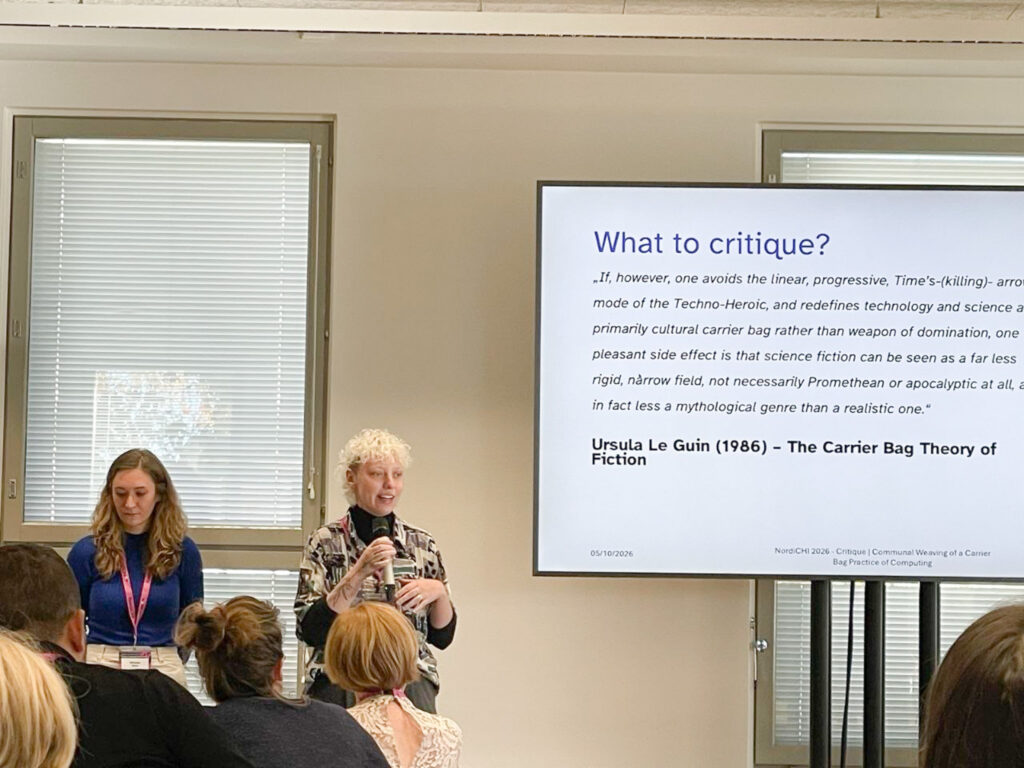
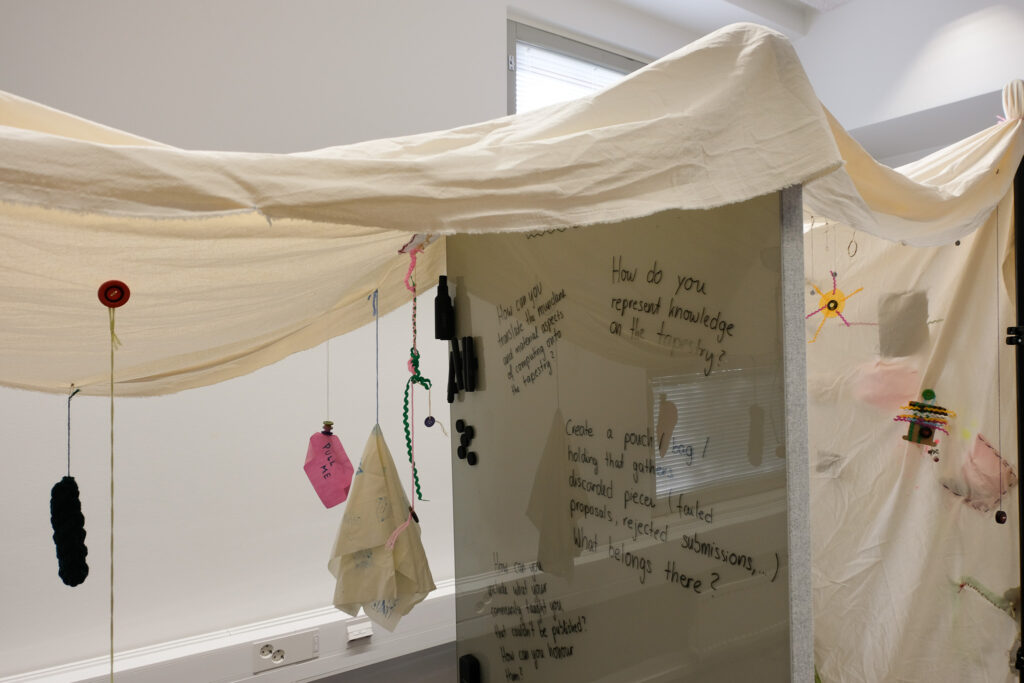
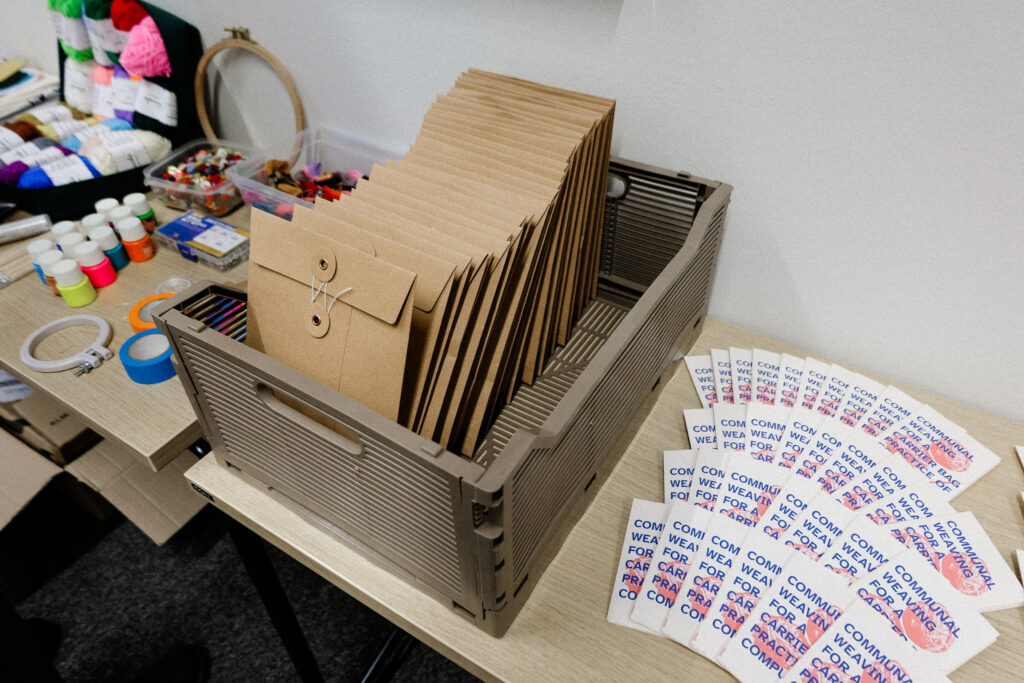
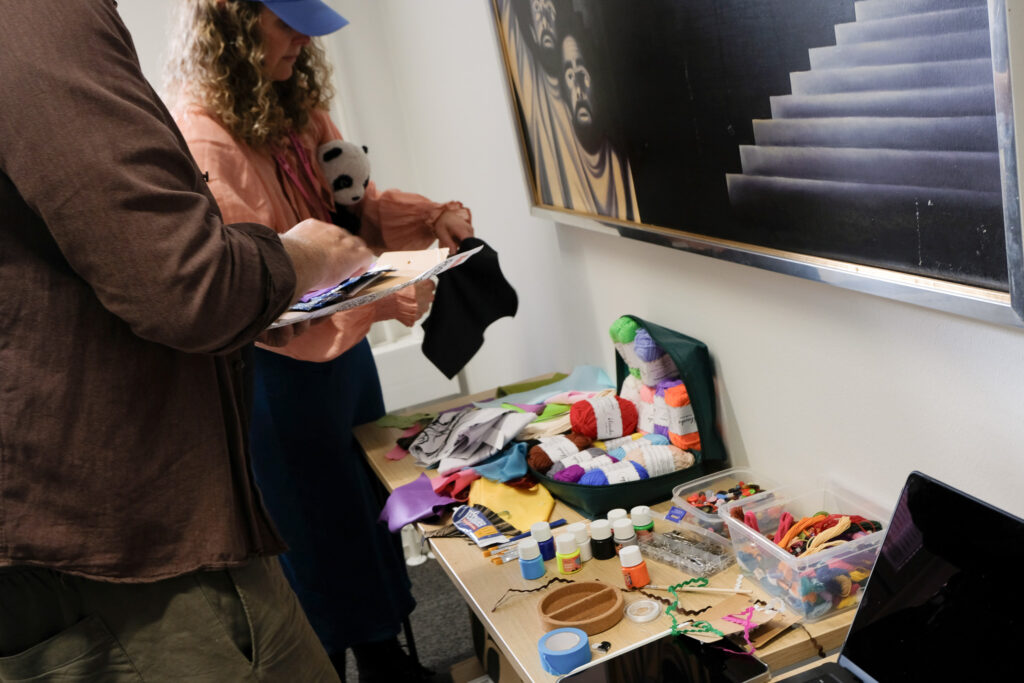
While pitching our critique for five minutes I looked into nodding and attentively listening faces. After our presentation conference attendees got the possibility to visit our interactive installation, explore it physically and use the provided material to contribute to it. Soon enough the room was filled with people sitting down and starting to stitch, knit, glue, and cut wool, yarn and fabrics. Contributors even shared and taught skills of knitting. Seeing this and having lovely encounters and chats with conference attendees who value the space for reflection through textile crafting we provided, motivates me a lot to pursue this as an ongoing project.”
Lea Stöter:
“It can be a daunting experiences to enter into a community space and critique or challenge the ways things are being done. Having gathered some confidence from listening to our colleagues’ critiques, we pitched our ideas and shared our invitation:
Leave a thread of knowledge, fellow weaver!
And people did! Either getting comfortable with balls of yarn, finger-knitting, asking for guidance making their first stitches on an embroidery hoop, or adding their thoughts directly onto the fabric. Conference attendants approached our cloth with curiosity and openness and we could not have asked for more. For me, there seemed to be an atmosphere of rest, liveliness, and playfulness in the room all the same time.
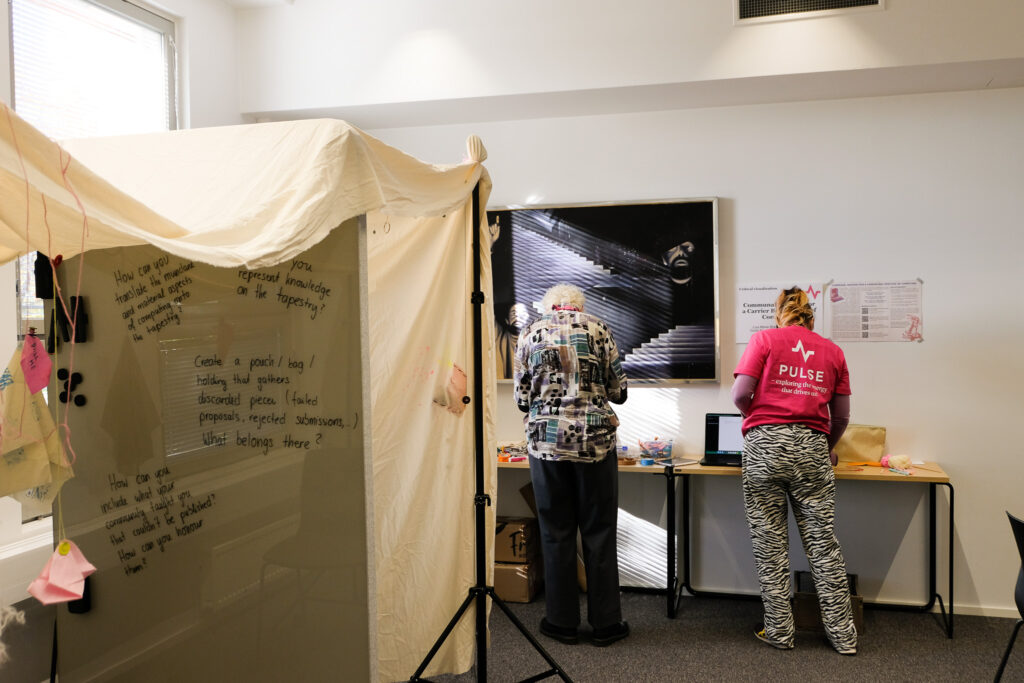
If you attend a conference with practitioners and designers, you are very likely to encounter questions such as “So what?” and “What are you going to do with this now?”, and so we did. With our contribution, we wanted to offer a space for reflection for reflection’s sake, to slow down and look at yourself and your own work and consider what else could be possible. I hope we conveyed this message. And sharing my concerns at the dinner table, I was reminded that our critique does not have to go anywhere, it can just be what it is and that would be enough.”
The entire invitation can be found here in a digital zine!
A Cloth is not Woven From a Single Thread: An Outlook for a Communal Weaving
As the physical piece of fabric containing our reflections has made it back safely to Kassel, the future of this project is still uncertain. We wish to bring this cloth as a space for slowing down to other venues to further share a reflective practice grounded in material engagement and the mundane. In the meantime, we aim to care for the digital cloth and its weavings, maintaining it, and finding ways to extend its threads.
Just as we did not want to answer the questions posed at the beginning of this text by ourselves, we also do not aim to keep the communal weaving tethered to us. Inspired by conversations at and around NordiCHI 2026, we are playing with the idea of local patchworks, thinking about ways this communal weaving practice could become decentralised and local, through a set of instructions or starter kits that can be shared or adapted.
As for now, we are slowly adding new contributions from the conference session to the digital cloth, so keep your eyes open for the new threads.
Leave a thread, fellow weaver!
Still, the practice of communal weaving for a Carrier Bag Practice of Computing does not only exist wherever the cloth is. It extends beyond both Vaasa and Kassel. The invitation we shared at NordiCHI 2026 still stands:
Did you take an envelope during the conference to knit together your thoughts in your own time? Do you have threads of words or woven images you want to share? Get in touch and share your thoughts and reflections: Contribution Form for a Communal Weaving